Programs
Here are notes on wolves while I researched my book,
“Charlie and the Wolf Pup.”
Hopefully, while you’re reading through these notes,
you will be intrigued to learn more about
these amazing creatures just like I did.
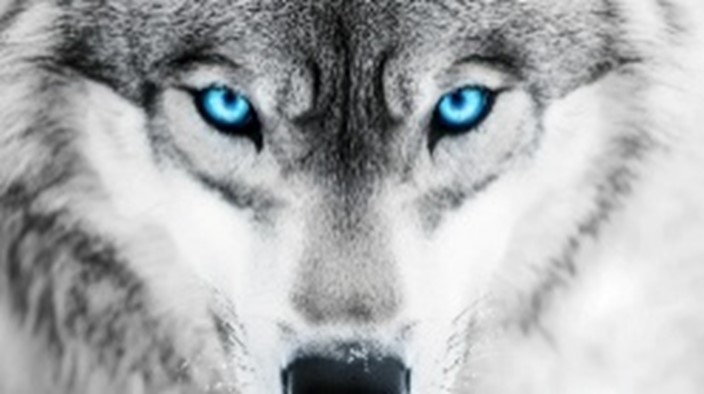
FIRST, LET’S LEARN ABOUT THE WOLF’S
PLACE IN THEIR ECOSYSTEM, AND HOW
THEY NEED OUR HELP!
The Grey Wolf are varied and diverse and the largest Canidae species, playing an important part in maintaining the health and balance of their ecosystems. Wolves’ hunting habits are crucial to the survival of those ecosystems, and are necessary to regulate the populations of other species.
In the 1920s, wolves were eradicated from Yellowstone National Park, and also eliminated from other landscapes. While the wolf’s ecological relevance as a predator was ignored, it led to significant declines in wolf population, which had a detrimental effect on their entire ecosystem.
With the wolf’s elimination, elk, deer, and other ungulates were grazing on vegetation quicker than it was able to regenerate, leading to a decline in plant species diversity, erosion control, and overall ecosystem health. Because of this decline in plant species, other animals, like birds and beavers, were suddenly faced with rapid habitat loss. With fewer trees and plants to stabilize the earth, soil erosion increased along riverbanks, impacting fish and other aquatic species as well.
Thankfully, in the 1990s, the reintroduction of wolves into Yellowstone Park resulted in the successful regrowth of plant life and the return of animal species. But still anti-wildlife policies continue.
Along with ongoing habitat loss, wolves have been poisoned, captured in cruel traps, shot for sport, or for their fur, or killed by farmers and hunters for perceived threats to livestock and game animals.
The biggest threat that the wolf faces has been from humans, and their misunderstanding. I hope to give a voice to wolves and reject well-known myths and fairytales that have given them a bad reputation.
We must spread the truth through education because human caused mortality continues to be the leading cause of early, often cruel, death for our wonderful wolves.
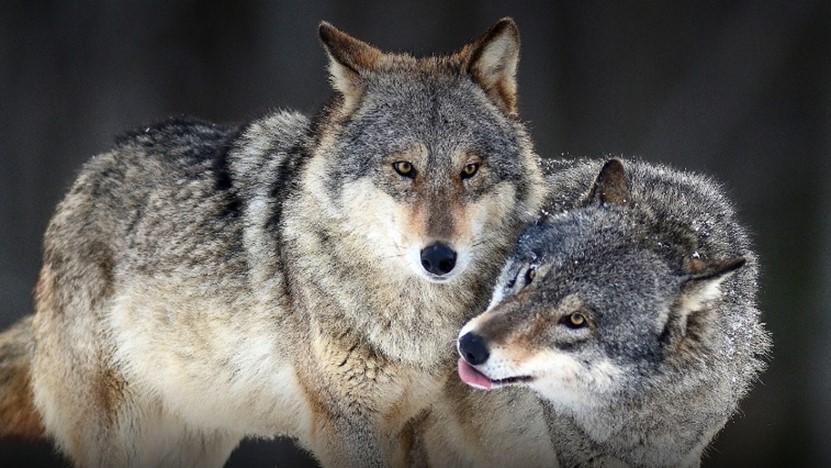
ABOUT WOLVES
Wolves are regarded as a SPIRIT ANIMAL
Instinctive, Survivor, Shrewd, Aware, Trustworthy, Patient, Devoted, Disciplined and Exuberant.
SYMBOLISM
Intelligence, Freedom, Communication, Loyalty, Love and Compassion, Secretive and Illusive.
Wolves are known as Intelligent and Illusive creatures.
The Wolf … Wild and Free …Shadows of Ourselves.
In animal society, weight, speed and guts count most. Add brains and you have leadership.
Wolves are shrewd, patient, aware, secretive, and defensive. Plus, they have the ability to show love, compassion, nurturing support, and affection within their pack system. They can be a clown at times, or act as a sage/leader/mentor, or a parent/teacher/disciplinarian. They are skilled hunters, and the image of strength, endurance, leadership, courage, quick wit, and coordination.
CANIS LUPUS, OR GREY WOLF, live in northern latitudes and are the most widespread wolf species in the wild, inhabiting areas across North America, Europe and Asia. They typically live five to seven years in the wild, and about 12 to 15 years in captivity.
Skull dimensions, size, color, and the length of appendages differ between subspecies of the grey wolf. They have large, squared mussels, and rounded, relatively short ears. Grizzled gray is the most common color of its coat, but they have a range of colors, including shades of brown, white, black, and gray.
SUBSPECIES
CANIS LUPUS ARCTUS, known as the Arctic Wolf
CANIS LUPUS LYCAON, commonly referred to as the Eastern Timber Wolf.
CANIS LUPUS OCCIDENTALIS, known as the Rocky Mountain Wolf, or Mackenzie Valley Wolf
CANIS RUFUS, or Red Wolf, inhabits the southeastern United States.
CANIS LUPUS FAMILIARIS, or domestic dogs, are descendants from grey wolves.
Alaskan malamute and the Siberian Husky are genetically closer to wolves than other dogs.
Dogs can generally interbreed with wolves.
ORDERS OF RANK
Alpha, Betra, and Gamma, second and third ranked wolves down through the Greek alphabet to Omega.
Dominant Posture
Visual signs and body attitude of dominance: still and unyielding, along with an aggressive snarl, and facial expression, with lips curled, and teeth exposed. Hackles are raised to make themselves appear bigger, with ears up, tail horizonal, or raised, and possible rear-end smelling taking place.
Submissive Posture
Lower Rank wolves often lick faces of higher rank wolves, with whines, head held down, ears flattened, and tails tucked between their legs. Roll over with belly-ups, allows for groin area to be sniffed.
WOLF’S CHARACTER
Many people are amazed by the shy, timid nature and remarkable loyalty they have toward their packs, often putting the needs of the group above their own. They have even been known to sacrifice themselves for the survival of the pack, or family unit.
Wolves are social animals, with bonding reinforced through behaviors such as grooming and playing, strengthening relationships and trust. They often display significant affection and other emotions toward each other. They have been seen to bury their dead, and mourn with feelings of loss. They mate for life … for better or for worse; through sickness and health; until death, do they part. Typically, only after death, do they decide to choose another mate.
PERSONALITIES
Wolves are creatures of many minds …wild, wise, threatening and loving, with a heightened capacity for devotion. They display feelings of joy, playfulness, seriousness, anxiousness, as well as being timid, sad and submissive, or strong, intuitive and intelligent, with gestures of suspicion.
THE WOLF PACK
A wolf pack functions more like a family unit than a strict hierarchy, operating with a balance of power, incorporated through strength, gentleness, and compassion. They share work and caregiving, while others take time away. They work, rest, whelp, and rove in cycles. The pack depends on cooperation, not strife, for its survival. Their discipline is firm, but not ruthless. Rules for the pack are laid down. Any disobedient ones are often chased from the pack.
The pack tends to be led by a dominant family pair, consisting of a male and a female wolf, their off spring, and yearlings. Either the male or the female can be the dominant leader. Younger wolves don’t challenge the oldest male for dominance of the pack; they just leave when they’re mature adults, at around three years of age, to start their own packs. Note: they don’t stay alone for long.
BREEDING
A defined breeding season typically occurs from February to March. After mating, the alpha female will prepare for the arrival of her pups by seeking out a suitable den. The gestation period lasts about 63 days. The new born pups typically weigh about one pound, and a typical liter size ranges from four to six pups.
Wolves commonly return to the same den for every birth. These dens can be found in rock crevasses, tree hollows, or even vacated burrows left by other animals. The dens can be quite large with long, deep tunnels, and possibly an underground chamber, securing the cubs safety.
Wolves typically breed once a year, the timing of which depends on where they’re located. Only the alpha of the pack will mate, leaving the rest of the adult pack members to help rear the young and ensure their survival. Note: an alpha male in search of a mate have been known to travel hundreds of miles away from their home territory.
WOLVES HAVE EXCELLENT HEARING & A STRONG SENSE OF SMELL, combining to create an enormous instinctive ability. They have been labelled “shadow” creatures, observing without being observed. They follow sound even in their sleep. They hear up to 126 KH, with an ability to detect high-pitched sounds, or sub-vocal notes, below the range of human registry. This sound is often used for the call to hunt, or to alert to an alien pack in the area.
HOW MUCH DO THEY EAT? “Wolfing it down.”
They can survive on about two and half pounds of food per wolf per day, but require about five pounds per day to reproduce successfully. They are known to eat mainly caribou, elk, white tail deer, moose and bison. But they never really know when their next meal will be. They can go for days between meals.
Once they’ve successfully taken down their prey, an adult wolf can consume as much as 20 pounds (nine kilograms) in one feeding. The alpha is the first to eat and will devour most of the meat. Other members of the pack follow to feed on the carcass (carrion). Any leftovers are for other scavengers, like ravens, coyotes, and vultures.
Massive molars and powerful jaws crush the bones of its prey with a biting capacity of 1,500 pounds of pressure per square inch (psi), making it possible to bite through a moose femur in six to eight bites. By comparison, a German shepherd dog has a biting pressure of 750 pounds per square inch. A human biting pressure is about 300 pound per square inch.
HOW MUCH DO WOLVES WEIGH?
Adult females weigh between 50 and 85 pounds, and are usually 10 to 15 pounds lighter than males.
Adult males can weigh between 70 and 120 pounds. Alaskan males weigh between 85 to 130 pounds.
HOW FAST CAN THEY RUN?
Long, lean and built for speed, wolves move in a highly efficient manner to prevent detection. They are masters of energy conservation even while moving. No matter how sick, lost, weakened, cornered, or afraid, the wolf never gives up. They have great endurance and perseverance. He/she will outwit, outlast, and outrun most any opponent.
Wolves travel long distances by cruising at a more leisurely pace of five miles per hour. They can travel more than a dozen miles each day. While hunting for food, they may travel 30 miles (50 kilometers) per day. When chasing prey, they sprint in short bursts at speeds of 25 to 35 miles per hour. They are also great at high jumping.
 PAW PRINT (Oh, what big feet you have!) an average wolf’s front paw is comparable to an adult human hand, at four inches wide, by five inches long. The rear paws are slightly smaller.
COMMUNICATION – LUPINE LINGUISTIC SIGNALS: Olfactory (visual) and Auditory (vocal)
Deep Song – Canto Hondo, used to communicate: howls, wails, shrieks, whines, grunts, snorting, snarls, growls, yips, calls and barks. Sounds to seethe, incite and encourage. An entire vocabulary of murmurs indulging a myriad of feelings: pleasure, pain, aggravation, fear, hate, anger, jealousy, and suspicion.
Whimper – intimacy, greeting, or submission.
Snarl – aggressive, lip curled, teeth exposed, raised hackles, ears up, tail raised or horizontal.
Growl – whine to high-pitched growl, threat or aggression, snapping lunge.
Bark (or quiet woof) alarm/threat to intruders.
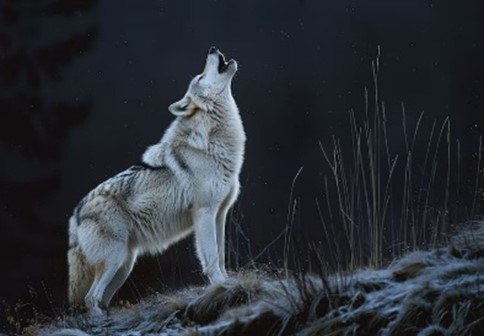
Howl – communication of all sorts.
HOWLING is a hauntingly beautiful, complex language – a direct transmission from the soul, from something deep inside them, something unrestrained, something noble, ancient and wild.
Howling – a pure, seductive echo that moans on eerily and can raise the hair on the back of your neck. It’s an entire, enchanting vocabulary of animal murmurs, using tone variations and keys. Howling is often done around mid-morning, in the evening, in summer when pups are young, or during mid-winter breeding season.
Inter-pack howling help wolves identify the size and strength of different packs, often determining whether or not to attack, or retreat. They harmonize rather than chorus on the same note, creating an impression of more animals than there are. Howling pups often sound similar to coyotes, with a mix of high-pitched yips, yelps, barks, and even sounds of yodeling.
As complex as the sounds are, they have distinct meanings to pack members, with each wolf having a distinct howl of their own used to defend territory, locate pack members, and convey messages. Uttered in innumerable tones for the same sounds, the howl effectively indicates attack or withdrawal, affection or rejection, assembly or dispersal, agreement or disagreement, joy or sadness, consent or refusal, friendship or enmity. High frequency treble is a more aggressive tone. Low treble resonates calm. A mournful, eerily howl rides the air, low and rising. On a flat surface, a wolf howl can be heard up to 10 miles (16 kilometers) away.
Olfactory or Visual Communication, as well as postural signaling, and scent marking.
Faces are designed to emphasize emotional content. No one can deceive a wolf!
Wily eyed – wild, wise soulful, and drawing.
Their eyes hold reproach, remorse, defiance, disdain, self-assurance, determination, and cunning.
Subjected to intense scrutiny: “Wolf probed into my being, reading me for weakness, for fear, for aggression, and above all for honesty.”
THE HUNT – “Strength in Numbers.”
Survival is by collective hunting and natural population control to protect their home and territory. They are exceptional hunters, due to a combination of physical strength, endurance, high intelligence, and established social strategies. They listen, sniff and snuffle, squint and peer, with inner hearing, and rudimentary thought.
Wolves are strong mammals with stamina that allows them to chase prey over long distances, often at speeds of up to 38 miles per hour (61 kilometers per hour). Referred to as marathon hunters, they have been known to track and stalk prey for hours, and well into the night. They are also at the top of the food chain, facing no natural predators of their own, except for possibly the grizzly bear. It is humans that they fear the most!
They prey on large, hoofed carnivores much larger than themselves, such as deer, moose and elk. Working together as a coordinated pack, wolves are able to launch attacks and ambush their prey with ease. There are times though that they’re badly injured, or even killed, during a take down. Each wolf takes on a different role in a hunt: some act as chasers to drive the prey towards other pack members, while others lie in ambush, or flank the prey animal to cut off escape routes. Wolves are strong animals with stamina that allows them to chase prey over long distances at high speeds. Wolves use their strength and powerful jaws to finally take down their kill.
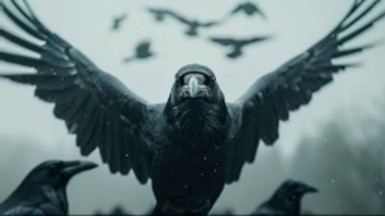
ABOUT RAVENS.
Common Raven: “Corvus corax.” Ravens, also known as the “Wolf” bird, are seen as very intelligent.
Because of a symbolic, mutualistic relationship of wolves and ravens, it is thought that wolves are able to interpret the calls made by ravens, indicating the location of their next meal. Ravens begin eating carrion quickly, arriving not just soon after a kill, but rather because of their close connection with wolves, they’re able to be there right when the kill is made.
Ravens are highly regarded for their complicated vocalization system, and excellent visual recognition. They make a lot of noise when they find a dead animal, drawing attention to the carcass so that larger, more “tooled” scavengers can open up the hide and hopefully provide food for them.
Ravens are known for their social skills. They play games of tail-chasing with each other, and especially with pups, and yearlings, developing special bonds with individual wolves within a pack. They have been known to grab sticks and play tug-of-war with wolf pups, or fly over small canines with sticks and tease them into jumping up to grab them. They even boldly pull at the tails of wolves to initiate a reaction.